Thursday, 5 March 2015

Lack Of Update


There's been very little update on my blog over the holidays. It was spent enjoying the company of friends and family visiting from Australia. It was also spent catching up on gaming. It was the first time I could spend all day and night simply gaming and doing very little else. I'm sure others were also as keen to do nothing but game.

But why spend all day and night gaming? What makes us absolutely focused on these games for hours on end? What makes this game "fun"? What is "fun" and how do we describe it?

I can't really say what's fun in games. There is, for me, a sense of great satisfaction and pleasure when I play for hours on end, whether it's with friends on Battlefield or War Thunder. I also enjoy playing single player games without any interaction with people over TeamSpeak.

I enjoy gaming as much as the next person and there can be a limit to how long is deemed appropriate or safe. There was a news item quite recently where a man in Taiwan spent 3 days solid gaming. The man, aged 38, died. There was also a previous death from another who spent 5 days gaming.

It's a fun activity to do, on your own or in a whole clan/guild of others, but like all things, it should be done in moderation!

This was also meant to be put up a few weeks back. Perhaps my time is wrongly spent!

Wednesday, 4 March 2015

British Museum Trip


On the 4th of December we went on a day trip to the British Museum where we spent the day learning about various board games that we were planning on writing about for our assessment. We toured around with Irving Finkle as he explained the various ancient board games that were on display such as The Royal Game of Ur.
We visited the many different areas that had board games relating to them, such as these two rock sculptures. At the base of them was a board game that was etched in to the stone.

I believe The Royal Game of Ur wasn't on display and a copy of it was instead. It was on loan to another museum but the fact we still saw a working copy was just as good. To be fair, if you really studied the pieces, it would seem as if it was the original set.


Dicing With Destiny


Games Britannia Part One:

Benjamin Woolley presented this series and began this video by telling us about his experiences growing up playing board games and some of his experiences and memories that came from it.

Benjamin himself is an Historian and began his quest looking at ancient games, one of which
was found during an excavation in Stanway. They discovered what looked like a board game and pieces close by. Since this finding there have been many discussions and theories on how the game was played.

Woolley then solicited the help of Irving Finkle. He came to the conclusion that this was some sort of war game played between two people. Banjamin started to inquire on how games that were played through history had some form of impact on cultures and religions around the globe.

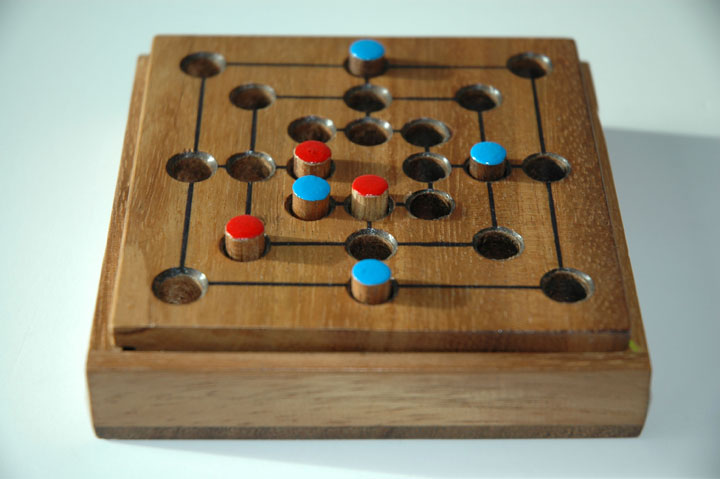
We play games simply because we become bored so easily. We ply them to pass the time and enjoyment. He made a note about a church he visited and said that there were markings on the steps where people would play games while waiting. 9 Men's Morris, similar to Noughts and Crosses, has remained and have done so throughout the years.


Soon games involving dice started to circulate and along with that, gambling. It was disliked by many in the 18th and 19th century. Even the dice were manipulated in some way which paved the way for cheaters to gain an upper hand.

Gambling became an incredible hit with the upper class. Faro, a simple version of Roulette was popular among the rich and was played by all who could afford it. However in 1985, a Gaming Act was introduced to try and curb gambling. A man who was killed over a £300 debt was one of the reasons this was pushed and eventually introduced.


Goose was a new game introduced that focused on good morals by rewarding, or penalising the players. It was a game that was copied and brought forward the commercialisation and profit of board games. Soon, games companies were coming up with their own rules and taking ideas from all around the world and hoped it would work, and eventually, sold on to the masses. Games such as Chess and Snakes and Ladders are some examples.


Wednesday, 26 November 2014

Tafl

Tafl!


During our last session we played a game of Tablut (tafl). There are two players involved in the game and each have their own corresponding pieces. One player will have eight white pieces while the other will have sixteen black pieces, all played on a 9x9 board.
The player with eight pieces will also have one other piece, a king that must escape to either the edge of the screen (as Murray specifies) or to one of the four markers in the corner of the playing board (others such as Schmittberger 1992; Helmfrid 2005 had suggested that the escaping to the edge was unbalanced)
The attacker had to ensure that the player with the king failed in reaching the edge, or corner, of the playing board. Each player had the opportunity to take out an opponent’s piece by surrounding it on two sides (adjacent to it). The attacking player, however, had to completely surround the king (again, depending on who is correct, on both sides or completely surrounded) in order for them to win. It is noted that a piece can move between two others and not be captured.
Players can move their pieces as they would a Rook in a game of chess: any number of squares in an orthogonal direction.
My opponent and I had two incredibly close games, once we had understood how to play of course. In the first game I had managed to get myself in a difficult position, and, only down to less than 5 pieces, I had managed to avoid being completely surrounded and I was able to get my King to the corner of the board.
I was then on the attack in round two and by this time we were making split second decisions, something I went to later regret as I had opened up an opportunity for Will to secure his King and win the game.

Wednesday, 12 November 2014

Senet and a Royal Game of Ur


The Royal Game of Ur is played with two sets of seven markers. One set is black, the other white along with tetrahedral dice. There was some speculation as to how this game was played.

It is suggested that players start on their own corresponding spots and the pieces enter and leave on the same block, a kind of circuit around the board and each player meets along a narrow bridge where they are able to take out each others markers. Another idea is that there is no combat of any kind and it is simply a race to get all of ones markers on and off the board before the other player.
Robert Bell seems to think that the rosettes present on the board have some sort of significance but it is unknown as to what. Becker comes to a conclusion that both player with 7 markers and 3 dice have to fight their way across the board but it is also unknown as to which direction or where they start and finish.

Senet was a difficult game to understand, I'll start with the rules:


We each had 7 identical playing pieces and 4 tetrahedral dice each tippexed with two white tips.

Score               Dice Combination
1                      Three plain and one marked    and Throw Again
2                      Two plain and two marked      END OF TURN
3                      One plain and three marked     END OF TURN
4                      None plain and four marked    and Throw Again
5                      Four plain and none marked    and Throw Again


1.      The first player to throw 1 begins play.
2.      Pieces can only move forward
3.      A piece may land on an empty square, or swap places with an opponents undefended place
4.      Two pieces of the same colour on adjacent squares defend one another and cannot be swapped
5.      Three consecutive pieces cannot be overtaken by the opponent.
6.      Throws of 1, 4 or 5 allow you to throw again.
7.      Successive throws are made before move a piece or pieces.
8.      Multiple throws can be subdivided between pieces, so if you throw a nine, you can chose to move one piece nine squares or to move one piece six squares and one piece three squares and so on.
9.      The last five squares with hieroglyphic signs have special meanings. Squares 26, 28, 29 and 30 are safe: if a piece is on one of these squares, the other players pieces cannot land on the square and swap with it.


Reading it back, it seems a lot clearer than it did when we were first presented with the player sheet and rules. Perhaps we didn't read the rules more thoroughly but I think we had to restart the game numerous times before we managed to understand it, if only, a little bit.
The idea behind it was that it was some form of race game but each piece had to make it to the end in order for either player to win. It makes for a very challenging and long game as you can easily prevent players from moving their pieces by simply having three in a row, which prevented them from moving, unless you (or they) made the move forward and opened up a space.


Friday, 24 October 2014

Battleships!


A Game nearly everyone has played in some form

It started out as a simple game of battleships. You get 5 ships and you can place them anywhere on your grid. The first one to sink the opponents ships, wins. Simple!

In our pairs we played a standard game of Battleships. Once the game was over we had to iterate on its design.

So what does that mean?

You have your game with the standard rules, and then you add to it. For example, we came up with the idea of allowing the player to initially have their first go, if they hit a ship, they were allowed one chance to follow up with a second go. It allowed both players to destroy each others ships in a quicker time but also gave a sense of relief and satisfaction if the other player missed.

Another iteration was allowing a 'super bomb' to be used. Every third go, the player could pick a grid, and the four adjacent tiles would also be affected by the bomb. So, even if the players initial grid was empty, there was still a chance for a ship to be hit in one of those other grids.


In our Wednesday lecture tried to understand how to define video games and how to categorize them.

We looked at the studies of James Newman who referred to Roger Caillois who came up with Paidia and Ludus.

Paidia can be simply explained as, “play” for pleasure
Ludus is defined as more constrained by rules, with a clear outcome (E.g. “Winning”)

He then furthered that by bringing in the following:

Agon: Competition - a competitive multiplayer game
Alea: Chance, Randomness - A gambling game or equivalent
Ilinx: Movement, Vertigo: - Outdoor sports, skiing, skateboarding
Mimicry: Simulation, Role-Play – Cinema


A game that came to mind when we were set this task was War Thunder which falls into the category of Ludus. I strongly believe this game can fall under the 4 categories explained above, if not, definitely 3.
War Thunder is based on tanks and aircraft throughout the Spanish Civil War through to the Korean War, with room to expand. Players take command of a plane or tank and are placed in equal teams and the objective can range from capturing positions, destroying certain targets, or the first time to lose all vehicles.  


World of Warcraft was a game I used to play and, to be fair, who hasn't? It offers the players with a huge sandbox to play in and gives people the freedom to do what they want, whenever and how they want to, which is why I think it can be categorized as a Paidia game. Feel like running around Goldshire killing rabbits? Go for it. Perhaps you want to just find a quiet spot and do nothing? Do as you please.


This is a game that could also fall under all 4 categories. Loot is based on a roll between 1 and 100, it’s an MMORPG and there are many strict Role-Playing servers who cater to those who want to role-play and for those who want a PvP or PvE only realm. Competitions between players in battlegrounds are also available. All accompanied with a ground of flying mount to get you around the world.